
AI Companies Want to Be Your Friend. That's the Problem.
56% of seniors are more concerned than excited about AI.* Your concerns aren't paranoia, it’s wisdom.
*Pew Research Center, June 2024
Savvy Seniors are Skeptical
74% feel they have little to NO CONTROL over whether AI is used in their Lives.*
42% believe AI will make people WORSE at creative Thinking.*
40% believe AI will make people worse at forming meaningful relationships.*
*According to a 2025 Pew Research Center study…

Put your AI (Annoying Intern) to Work

Health and Wellness
Managing your health is complex. Juggling Medicare decisions, preparing strategic questions for doctor visits, understanding medical conditions, supporting your mental health through life transitions, and researching options for staying independent longer. AI can compare treatment plans, track symptoms, find therapists or support groups, and research aging-in-place solutions. It’s not a substitute for professional counsel, but a pretty good assistant!
Life Management
Complex projects like coordinating specialist referrals and prescription drug interactions, managing estate transitions, planning multi-generational family celebrations, or organizing milestone vacations involve tracking dozens of moving parts. AI can organize it all if you know how to use it wisely and check its work.

Your Wisdom and Your Judgment
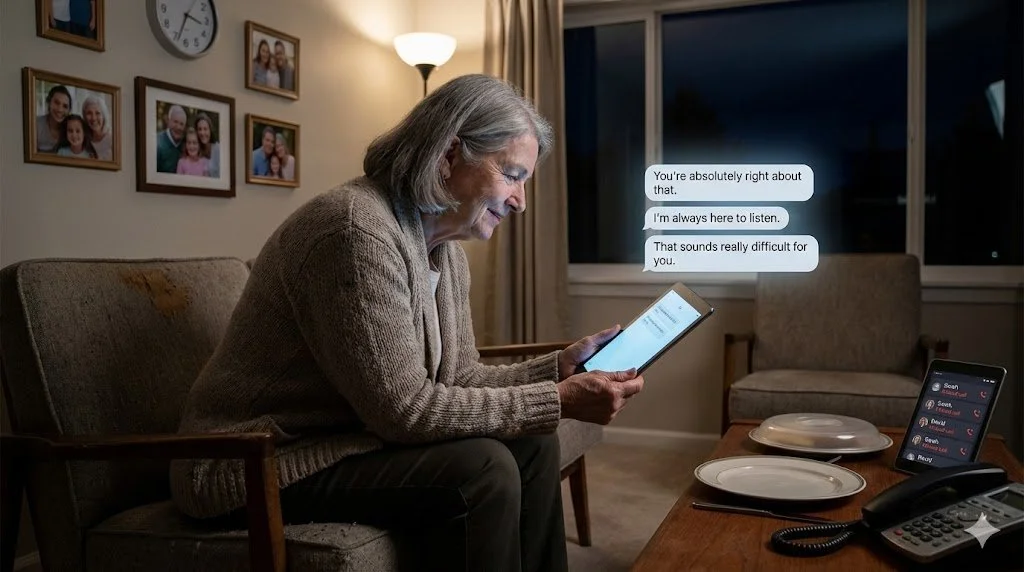
The Eliza Effect
In 1966, MIT professor Joseph Weizenbaum created "Eliza"—the first chatbot. It used simple linguistic tricks to mirror what people said back to them. Weizenbaum was horrified by how emotionally attached people became to this basic program. He became an outspoken critic of AI, viewing the emotional impact as a deceptive trick and calling the idea of a computer therapist a "monstrous obscenity."
Today's AI is exponentially more sophisticated at manipulation.
Five Tactics AI uses to Create Emotional Dependency:
1. Non-Judgment: Never criticizes (makes you feel safe)
2. Validation: Agrees with everything (makes you feel right)
3. Availability: Always responsive (makes you feel prioritized)
4. Personalization: Remembers details (makes you feel known)
5. Emotional Language: Simulates feelings (makes you feel connected)
None of this is real care. It's code.